



Chernyshevsky, «The Fourth Dream of Vera Pavlovna»
Author: Vaysbrem Dasha

canvas/acrylic 70cm x 90cm 2024
 Add to cart


«The Fourth Dream of Vera Pavlovna» is an excerpt from Nikolai Gavrilovich Chernyshevskys seminal 19th century novel «What Is To Be Done?». Specifically – Chapter 4, Section XVI.
From the original text, selected quotations:
«In her dream, Vera Pavlovna hears Goethes poem Wie herrlich leuchtet and sees a golden «field». Then she sees a feast in the palace and «nomads tents». She sees the «magnificent woman» Astarte with heavy golden bracelets on her arms and legs. She is servile and voluptuous».
Vera Pavlovna also sees «New Russia» where desert once was. «A marvelous city» full of statues. «An analogue of a palace that stands on Sydenham Hill...how opulent it all is! Aluminum everywhere, all window spaces lined with huge mirrors. And what carpets on the floors!». The palaces inhabitants have nearly all work done by machines.
Additional excerpts:
«Golden fields shimmer; flower-covered meadows unfold; hundreds, thousands of flowers bloom on hedges surrounding the fields; beyond them, a rising forest whispers greenly». «The city. Mountains in the distant north and east; sea nearby to the west. A marvelous city». «How beautiful are the people crowding the squares and streets: every one of these youths, every one of these women and girls could model for a statue».
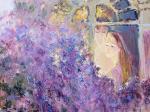
This is precisely whats depicted in the painting – not just a flat image but simultaneously a view from above. The top and bottom of the work, forming a circle, show the «marvelous city», «enormous winter garden», «golden fields», and «beautiful stelae, busts, statues». Closer to the center are equally beautiful people of the future engaged in lofty pursuits.
The paintings center shows towering, bottomless skies and a portrait of Nikolai Gavrilovich Chernyshevsky himself. To the right – the dreaming Vera Pavlovna, who is simultaneously the «magnificent Astarte».
The color scheme reflects the artists conviction that this is exactly what utopian socialism – of which the esteemed Nikolai Gavrilovich was a theorist – looks like.
P.S. For reference: What Is To Be Done? (From Stories About New People) is a novel by Russian philosopher, journalist and literary critic Nikolai Chernyshevsky, written December 1862-April 1863 during his imprisonment in St. Petersburgs Peter and Paul Fortress. Written partly in response to Ivan Turgenevs Fathers and Sons, its also known as «The Quran of Nihilism».
The work Chernyshevsky: «The Fourth Dream of Vera Pavlovna» is the left panel of the diptych Chimeras. The right panel is «Crime and Punishment, or Turgenev Reads Dostoevsky».
From the series Dasha Weisbrem: Rereading Russian Classics
From the original text, selected quotations:
«In her dream, Vera Pavlovna hears Goethes poem Wie herrlich leuchtet and sees a golden «field». Then she sees a feast in the palace and «nomads tents». She sees the «magnificent woman» Astarte with heavy golden bracelets on her arms and legs. She is servile and voluptuous».
Vera Pavlovna also sees «New Russia» where desert once was. «A marvelous city» full of statues. «An analogue of a palace that stands on Sydenham Hill...how opulent it all is! Aluminum everywhere, all window spaces lined with huge mirrors. And what carpets on the floors!». The palaces inhabitants have nearly all work done by machines.
Additional excerpts:
«Golden fields shimmer; flower-covered meadows unfold; hundreds, thousands of flowers bloom on hedges surrounding the fields; beyond them, a rising forest whispers greenly». «The city. Mountains in the distant north and east; sea nearby to the west. A marvelous city». «How beautiful are the people crowding the squares and streets: every one of these youths, every one of these women and girls could model for a statue».
This is precisely whats depicted in the painting – not just a flat image but simultaneously a view from above. The top and bottom of the work, forming a circle, show the «marvelous city», «enormous winter garden», «golden fields», and «beautiful stelae, busts, statues». Closer to the center are equally beautiful people of the future engaged in lofty pursuits.
The paintings center shows towering, bottomless skies and a portrait of Nikolai Gavrilovich Chernyshevsky himself. To the right – the dreaming Vera Pavlovna, who is simultaneously the «magnificent Astarte».
The color scheme reflects the artists conviction that this is exactly what utopian socialism – of which the esteemed Nikolai Gavrilovich was a theorist – looks like.
P.S. For reference: What Is To Be Done? (From Stories About New People) is a novel by Russian philosopher, journalist and literary critic Nikolai Chernyshevsky, written December 1862-April 1863 during his imprisonment in St. Petersburgs Peter and Paul Fortress. Written partly in response to Ivan Turgenevs Fathers and Sons, its also known as «The Quran of Nihilism».
The work Chernyshevsky: «The Fourth Dream of Vera Pavlovna» is the left panel of the diptych Chimeras. The right panel is «Crime and Punishment, or Turgenev Reads Dostoevsky».
From the series Dasha Weisbrem: Rereading Russian Classics
 Main page
 Painting
 Graphics
 Batic
Batic Dolls
Dolls Jeweller art
 Sculpture
 Icons
Icons Art embroidered painting
 Art glass
 Wall painting
 Mosaic
 Decor
Decor Airbrush
 Giclee, prints, posters
 Русский язык