







 Add to cart


He lives among us, normal people, in the real world. But he perceives and feels the world differently than everyone else. His emotions are insanely sincere, and he is more decent than is rationally normal for living among us. Being weak himself, he comes to the aid of those even weaker than him, unaware of the risk.
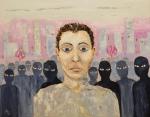
His lonely figure stands out against the faceless crowd, his gaze strangely focused, turning his humanity inside out. His distorted gaze disturbs the viewer, challenging the boundary between identity and perception. If you look closely, it becomes clear that his eyes are inverted, symbolizing his wrongness. Even his surroundings are seen differently when viewed through his eyes; it is enough to turn the picture upside down. Surrounded by anonymous observers, he embodies the fate of those who are judged as “wrong” simply because they are different, or because they are not like them.
The work seems to be inspired by and echoes Dostoevskys novel The Idiot, where innocence itself is condemned as madness. Here, wrongness is not hidden — it is imprinted on the body, face, and gaze. The painting is a reflection on alienation, social condemnation, and the fragility of individuality in a world of conformity.
The picture can be hung on the wall without a frame since the image is going on the ends.
His lonely figure stands out against the faceless crowd, his gaze strangely focused, turning his humanity inside out. His distorted gaze disturbs the viewer, challenging the boundary between identity and perception. If you look closely, it becomes clear that his eyes are inverted, symbolizing his wrongness. Even his surroundings are seen differently when viewed through his eyes; it is enough to turn the picture upside down. Surrounded by anonymous observers, he embodies the fate of those who are judged as “wrong” simply because they are different, or because they are not like them.
The work seems to be inspired by and echoes Dostoevskys novel The Idiot, where innocence itself is condemned as madness. Here, wrongness is not hidden — it is imprinted on the body, face, and gaze. The painting is a reflection on alienation, social condemnation, and the fragility of individuality in a world of conformity.
The picture can be hung on the wall without a frame since the image is going on the ends.
 Main page
 Painting
 Graphics
 Batic
Batic Dolls
Dolls Jeweller art
 Sculpture
 Icons
Icons Art embroidered painting
 Art glass
 Wall painting
 Mosaic
 Decor
Decor Airbrush
 Giclee, prints, posters
 Русский язык